Providing Best Services in Huntsville & Madison, AL


Follow us on Social.





Sep 1, 2026

3 min

Edging & Borders
How to Bend Metal Landscape Edging
To bend metal landscape edging, work the metal cold and match the technique to the shape you want. Sharp corners get a scored line and a lever against a 2x4. Curves get gradual pressure applied across several passes rather than one, with extra bend allowed for springback.
Both techniques are within reach of a homeowner with basic tools, and neither involves heat. Below we cover the tools, the minimum radius a curve can hold before the metal kinks, the two corner methods and how they differ, what springback does to your measurements, and the handful of mistakes that ruin a piece of edging past saving.
How Do You Bend Metal Landscape Edging?
You bend metal landscape edging cold, using one of two techniques: score the metal and lever it over a 2x4 for a sharp corner, or apply gradual pressure in several passes for a curve. The shape you want determines which technique applies, and mixing them produces poor results in both directions.
Sharp corners need a stress concentrator. Scoring a line across the edging weakens the metal along that exact line, so the bend happens where you decided rather than wherever the metal happens to give first. Curves need the opposite: stress spread evenly along the whole arc, with nothing concentrating it in one spot.
Neither job requires a shop or specialized equipment. A manufacturer's own instructions put a single corner at about five minutes with a 2x4 and a marker. The reason a clean bed line still reads as professional has less to do with equipment than with planning the bends before cutting anything, which is one of the quieter benefits of edging done deliberately rather than improvised on site.
Where the shapes get complex or the runs get long, the labor adds up fast. Professional edging installation costs more than a weekend of your own time, and it buys bends that land where the design says they should.
What Tools Do You Need to Bend Metal Landscape Edging?
You need a 2x4, a marker, a rubber mallet, safety glasses, and gloves to bend metal landscape edging, plus an angle grinder or hacksaw for sharp corners and rope with stakes for large curves. Nothing on the list is specialized, and most of it is already in a garage.
- 2x4 lumber. The fulcrum for corner bends. A short offcut is enough.
- Marker or chalk. Mark the bend location before touching the metal. Bends placed by eye land in the wrong spot.
- Angle grinder or hacksaw. For scoring a sharp corner. Either works; the grinder is faster and the hacksaw is quieter and more controllable.
- Metal file. For dressing the score line and knocking down any burr left after cutting.
- Rubber mallet or soft-faced hammer. Seats the edging into the trench without denting or deforming the top.
- Rope and two wooden stakes. For forming large-radius arcs, set roughly 12 inches apart.
- Safety glasses and gloves. Sheet metal edges are sharp before they are filed, and grinding throws sparks and fragments. Both are required rather than optional.
A powered bender has no place in this job. Landscape edging is thin enough that hand leverage produces better control than a machine, and machines tend to overbend material this light.
Can You Curve Metal Landscape Edging?
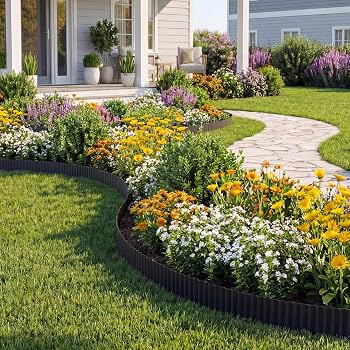
Yes, you can curve metal landscape edging, and gentle curves are what the material handles best. Steel edging is manufactured to flex along its length, which is why it ships in coils and long strips rather than rigid panels.
The limit is radius rather than whether curving is possible at all. Push a curve tighter than the metal tolerates and it stops curving and starts kinking, which is a permanent crease that cannot be worked back out. Planning bed shapes around curves the material can actually hold is part of what makes a landscape design buildable rather than merely drawable.
Gentle curves also outperform tight ones in service. A sweeping arc distributes soil pressure along its length, while a tight curve concentrates it and slowly pushes the edging out of line. Deciding whether a bed even needs a hard border, and what shape that border should take, comes before any of this, and it is worth settling whether the flower bed edging is doing containment work or purely visual work.
What Is the Minimum Bend Radius for Metal Landscape Edging?
The minimum bend radius for metal landscape edging is roughly 6.5 feet for 3mm material and roughly 13 feet for 6mm material, with thinner residential edging tolerating considerably tighter curves. Manufacturer guidance for heavier Corten specifies a 2 metre minimum radius at 3mm thickness and a 4 metre minimum at 6mm.
Those figures describe heavier material than most homeowners buy. Common residential steel edging runs about 18 gauge, roughly 1.2mm, which is less than half the thickness of the 3mm product those radii apply to. Thinner steel bends to tighter arcs before it kinks, so treat the published numbers as the ceiling for heavy edging rather than a rule for the light stuff.
The practical test costs nothing. Flex a scrap piece by hand into the tightest curve your design calls for. If it forms a smooth arc it will hold; if you feel it want to fold at a point, the radius is too tight and the design needs opening up.
How to Curve Landscape Edging
You curve landscape edging by marking the arc, then applying pressure gradually across several passes rather than forcing the shape in one motion. Incremental bending is the whole technique, and it is the step most people skip. Here is the sequence:
- Mark the arc on the edging. Draw the intended curve on the metal with chalk or a marker before bending anything, so you have a reference to check against.
- Lay the edging along the bed line. Dry-fit against the actual curve you are matching rather than working from measurements alone.
- Set two stakes about 12 inches apart. Drive them into the ground and position the edging between them.
- Loop a rope around the edging and the stakes. Tighten it gradually. Rope tension bends the metal evenly instead of concentrating force where your hands are.
- Work along the arc in passes. Move the setup down the length and repeat, taking a little more curve on each pass. Several light passes beat one heavy one every time.
- Overbend slightly for springback. Steel returns partway toward straight when released, so aim past your target.
- Check against the bed line and adjust. Dry-fit again, then take another light pass wherever the arc falls short.
Incremental bending forms the curve across several passes instead of one. Several passes distribute the stress along the whole arc rather than concentrating it at a single point. Concentrated stress at a single point is what produces a kink, and a kinked piece of edging cannot be straightened back out.
What Is Springback and How Do You Allow for It?
Springback is the tendency of bent steel to return partway toward its original shape when pressure is released, and you allow for it by deliberately overbending past your target. Every bend in steel has an elastic component that recovers and a plastic component that stays, so what you see under pressure is always more curve than what you get after.
How much to overbend depends on thickness and how tight the curve is, which makes a test piece worth the material. Bend a scrap, release it, and measure the difference. That gap is your correction, and it stays consistent across the same material and the same radius. Heavier weathering steel is documented as holding its bent shape long term without further springback or fatigue deformation once formed, so the correction only has to be made once.
How to Bend a 90-Degree Corner in Metal Edging
You bend a 90-degree corner in metal edging by scoring a line across the face, laying a 2x4 over the edging at the score, standing on the lumber, and raising the free end toward you until the metal folds at the line. Position the corner so a standard length is split evenly, roughly 2 feet each side on a 4-foot section, which keeps both legs long enough to stake properly.
Skipping the score gives you a rounded corner instead of a sharp one using the identical lever technique. Manufacturer guidance is clear that there is no functional difference between the two, only an aesthetic one, so the choice is purely about the look you want. Sharp corners suit formal, geometric beds; rounded corners suit informal planting and flowing lines.
Corner TypeMethodTools NeededAppearanceApprox. TimeSharp 90-degreeScore the line, then lever over a 2x4Angle grinder or hacksaw, 2x4, fileCrisp architectural angleAbout 5 minutesRounded cornerLever over a 2x4 with no score2x4 onlySoft radius, informalUnder 5 minutesPerforated edgingFold at factory perforationsNoneFaceted, angle set by hole spacingSecondsLarge-radius arcRope and stakes, incremental passesRope, 2 stakesSmooth sweeping curve10 to 15 minutes per section
Sources: Coyote Landscape Products steel edging cornering guidance; AHL Corten bending and radius specifications; manufacturer product specifications for perforated weathering steel edging.
A third option exists that neither technique covers. Some weathering steel edging ships pre-perforated at fixed intervals, commonly every few inches, so it folds to any angle by hand without tools at all. The trade is that your angles land where the perforations are rather than where you want them. Matching edging decisions to adjacent stone, walkways, and borders keeps the whole yard reading as one piece of work, which is where edging overlaps with hardscaping rather than sitting apart from it.
Crisp corners are one of the details that separates a yard that looks maintained from one that looks finished. Most of what makes a yard professionally landscaped comes down to lines being deliberate rather than approximate.
Do You Need to Score Edging Before Bending It?
You need to score edging before bending it only when you want a sharp corner, since scoring is what forces the fold to happen at one exact line. Cut deep enough to create a real indentation, particularly through any rolled top edge, since a shallow score lets the metal round off instead of folding cleanly.
Do not cut all the way through. A score is a weakening, not a separation, and cutting too deep leaves a corner that snaps under soil pressure within a season. File the score line afterward to remove the burr, which is both a safety matter and a rust prevention one on galvanized material.
Do You Have to Heat Metal to Bend Landscape Edging?
No, you do not have to heat metal to bend landscape edging, and heating it causes more problems than it solves. Every technique in this guide is a cold bend, and landscape edging is manufactured thin enough that cold working is entirely sufficient.
Heat damages the protective coating that keeps the edging from rusting. Galvanizing burns off well below the temperature that would soften steel meaningfully, and powder coating scorches and lifts. On weathering steel the patina layer that provides corrosion resistance gets disrupted too. In all three cases you trade a small gain in workability for a large loss in service life.
Can You Bend Metal Edging by Hand?
Yes, you can bend thinner metal edging by hand, and 3mm material is documented as bendable by one person without specialized tools. Common residential edging is thinner still, so hand bending handles most gentle curves. Corners are the exception, since a crisp fold needs the leverage a 2x4 provides. Wear gloves regardless. Sheet metal edges cut skin easily, particularly at cut ends before they have been filed.
How Thick of Metal Edging Can You Bend?
You can bend up to roughly 6mm edging with hand tools, though anything above 3mm benefits from two people and a longer lever. Residential edging typically runs about 18 gauge, near 1.2mm, and bends readily. Commercial-grade material at 3mm to 6mm needs more force and a wider bend radius. Thickness also drives height and rigidity, so comparing edging types on gauge as well as material tells you how much shaping work a project will involve before you buy anything.
Common Mistakes When Bending Metal Landscape Edging
The most common mistakes when bending metal landscape edging are forcing a curve in one pass, cutting the score too deep, ignoring springback, and bending against the rolled top edge instead of with it. All four ruin the piece rather than merely making the job harder, and all four are avoidable.
Single-pass curving is the most frequent. Impatience concentrates force at the point where your hands are, and the metal folds there instead of curving along the length. The resulting kink is permanent, since straightening it work-hardens the crease and usually cracks it.
Over-scoring is the second. A score cut most of the way through produces a beautiful corner that fails the first time soil pushes against it. Cut an indentation, not a separation.
The rolled top edge causes the subtler problem. Most quality edging has a rolled or hemmed top for rigidity and safety, and that roll resists bending far more than the flat face does. Bending in the direction the roll wants to go is straightforward; bending against it distorts the roll and leaves a wavy top line. Getting these details right consistently across a whole property is a large part of why professionally installed edging holds a cleaner line than most first attempts.
Rushing the layout underlies all of it. Bends placed before the bed line is finalized mean cutting new pieces later, and mismatched curves are among the more visible design mistakes in a finished yard because the eye follows a line and notices exactly where it wobbles.
How to Connect Metal Landscape Edging Sections
You connect metal landscape edging sections by overlapping the ends several inches and securing them with connector clips or stakes driven through both layers. Most systems ship with couplers sized for their own profile, and overlapping rather than butting keeps the joint from opening as soil shifts.
Joints belong on straight runs wherever possible. A connection placed mid-curve fights the bend and tends to pull apart, so plan section breaks for the flat stretches between curves. Trench depth, staking intervals, and seating the finished run are their own topic, and the full sequence to install edging covers the ground work that happens after the shaping is done.
How Long Does Metal Landscape Edging Last?
Metal landscape edging lasts 15 to 25 years or more depending on material, with weathering steel documented at over 20 to 25 years and galvanized steel falling in a similar range when the coating stays intact. Metal substantially outlasts plastic and rubber alternatives, which is most of the argument for choosing it.
Weathering steel behaves differently from coated steel in an interesting way. It rusts deliberately, forming a stable patina over roughly three to ten years that then protects the metal underneath. Scratches picked up during bending self-heal as that patina reforms over them, so handling marks matter less than they would on a coated product.
Galvanized and powder-coated steel depend on their coating staying unbroken. Every score line, cut end, and deep scratch is a place where corrosion starts, which is the practical reason for filing cut edges rather than leaving them raw.
Climate shortens or extends those ranges. Huntsville combines high summer humidity with a real freeze-thaw cycle, and both work on any break in a protective coating faster than a dry climate would. On the Madison beds where we installed steel edging years ago, the sections that have held up best are the ones where cut ends were dressed properly at install.
Profile choice affects longevity too, since edging that gets struck by a mower every week takes more damage than edging the mower rides over. A mow over edging profile removes that repeated impact entirely.
Whatever the material, a properly seated edge is also the most effective barrier against grass creeping into beds, and keeping the depth right matters as much for that job as for durability. Homeowners fighting to keep grass out of their beds are usually fighting an edge that was set too shallow.
Anyone weighing a full run against a weekend of their own bending will find the calculation turns on linear footage and the number of curves. Straight runs are easy; a yard full of sweeping beds is where a professional landscape installation earns its keep.
How to Remove Metal Landscape Edging
You remove metal landscape edging by pulling the stakes first, then working a flat spade under the run and levering it upward in sections. Pulling the edging before the stakes bends the metal around them and destroys both. Cut connector clips with tin snips where they resist rather than forcing the joint apart. Wear gloves, since buried edging develops sharp corrosion edges, and lay removed sections flat rather than coiling them if you intend to reuse the material.
Frequently Asked Questions
Can You Bend Metal Edging With Pliers?
Pliers work for small adjustments at the ends of a run, though they leave tool marks and cannot produce a clean corner or a smooth curve. The jaws concentrate force in a narrow band, which is exactly what causes kinking on a longer bend. Use pliers to tweak a stubborn end, and a 2x4 for anything structural.
How Hard Is It to Bend Metal Landscape Edging?
Bending metal landscape edging is not hard, and a single corner takes about five minutes with basic tools. Residential-gauge steel flexes readily by hand for curves, and corners need only the leverage of standing on a 2x4. The difficulty is in accuracy rather than force, since getting the bend in the right place takes more care than getting it to bend at all.
Can You Bend Edging After It Is Already Installed?
You can make small adjustments to installed edging, but reshaping a run properly means pulling the stakes first. Bending staked edging in place levers against the stakes, which loosens them and distorts the metal at each anchor point. Pull the stakes along the section you want to reshape, adjust the curve, then re-stake at fresh positions.
What Happens If You Bend Metal Edging Too Far?
Bending metal edging too far produces a kink, which is a permanent crease that cannot be worked out. Attempting to straighten a kink work-hardens the metal at the fold and usually cracks it. On a scored corner, over-bending can also tear the metal along the score line. Cut out the damaged section and connect a fresh piece rather than trying to repair it.
Can You Reuse Metal Edging After Removing It?
Yes, you can reuse metal edging after removing it, provided the run is free of kinks and the coating is largely intact. Straighten gentle bends by reversing the technique used to make them, working gradually. Discard any section with a kink, a crack at a score line, or corrosion that has eaten through the coating, since those spots will fail first in the new installation.
How Long Does Rubber Landscape Edging Last?
Rubber landscape edging typically lasts 5 to 10 years, considerably less than metal. Rubber and plastic both degrade under UV exposure, becoming brittle and cracking, and they heave more readily in freeze-thaw cycles because they lack the rigidity to resist soil movement. Rubber costs less upfront and installs faster, so it suits temporary or low-traffic borders where a shorter service life is acceptable.
What It All Comes Down To
Bending metal landscape edging is a cold-working job with two techniques and one governing principle. Score and lever over a 2x4 when you want a sharp corner. Apply gradual pressure across several passes when you want a curve. The principle underneath both is that stress concentrated at a point produces a kink and stress distributed along a length produces a shape, which is why patience matters more than strength here.
Mark before you bend, overbend to beat springback, file every cut edge, and test a scrap before committing a full-length piece. If your yard has more curves than straight runs and you would rather the bends land exactly where the design says, we are glad to take a look and talk through what the shapes will actually require. You can see more of our work at White Shovel Landscapes or reach us at 256-612-4439.



You May Also Like

Sep 12, 2026
3 min
How to Keep Landscape Edging Straight
Sep 11, 2026
3 min
How to Decorate a Patio: Ideas for 2025 and 2026
Sep 9, 2026
3 min
How to Trim Around Landscape Edging
Sep 7, 2026
3 min
What Does a Lawn Look Like After Aeration
Have a Project in Mind?
If this post sounds like your yard, tell us about it. Request an estimate online or give us a call, and we’ll talk through what your property needs.





Transforming Huntsville & Madison yards since 2011 with expert landscape design, garden makeovers, mulching, and top-quality installations.


