Providing Best Services in Huntsville & Madison, AL


Follow us on Social.





May 18, 2026

3 Min

Landscaping
Soil Retention Techniques for Residential Yards
Soil retention techniques for residential yards include retaining walls, ground cover plantings, French drains, proper grading, mulching, and terracing to keep soil in place and protect your property from erosion and water damage.
Soil retention techniques for residential yards keep the ground where it belongs by combining drainage, plantings, structural support, and soil management into one system. Without these techniques, rain, runoff, and gravity slowly strip away the topsoil that your lawn, garden beds, and foundation depend on. The right approach depends on your yard's slope, soil type, and where the water flows during a storm.
This article covers the most effective soil retention methods for homeowners, from simple fixes like mulching and ground covers to professional solutions like retaining walls and French drains. We explain how each technique works, when to use it, and how to combine them for the strongest protection.
Why Soil Retention Matters for Residential Yards
Soil does not stay put on its own, especially during heavy rain. Every storm moves a little more dirt off your property, and over time, those small losses add up to serious problems. According to the USDA Natural Resources Conservation Service (NRCS), the United States loses approximately 1.70 billion tons of soil per year to wind and water erosion. Penn State Extension estimates this costs $37.6 billion annually in lost productivity at the national level.
In a residential yard, soil loss shows up as thinning grass, exposed tree roots, gullies along slopes, muddy patches after rain, and foundation gaps where the soil has pulled away from the house. If you have ever noticed your mulch beds getting thinner without touching them, or your garden beds sitting lower than they used to, erosion is the reason.
Keeping soil in place is not just about having a nice-looking yard. It protects your home's foundation, prevents drainage problems, preserves the nutrients your plants need, and maintains your property's value. Yard erosion left unchecked can undermine everything from your garden beds to the concrete under your house. Research from Virginia Tech found that homes with well-designed landscaping can be worth 5.5 to 12.7 percent more than homes with poor or no landscaping. A yard that is slowly washing away sends the opposite message to buyers.
How to Stop a Yard From Washing Away
To stop a yard from washing away, you need to slow down the water, redirect it, and anchor the soil. Those three goals drive every soil retention technique that works long-term.
Slowing down the water means covering bare soil with mulch, plants, or rock so raindrops do not hit the ground at full speed. A global meta-analysis published in the journal Geoderma, covering 90 separate studies, found that mulching alone reduces soil loss by an average of 76.2 percent. That is a dramatic improvement from just covering the ground.
Redirecting the water means using grading, drains, and channels to move runoff away from vulnerable areas and toward safe discharge points. If your yard slopes toward the house or pools in low spots, every rainstorm does damage until you fix the flow pattern.
Anchoring the soil means planting deep-rooted vegetation, building retaining walls, or amending the soil so it holds together better. Research from Oklahoma State University Extension found that vegetated areas produce only 10 to 20 percent water runoff, compared to 60 to 70 percent from bare soil. That difference is what separates a yard that holds from one that washes away.
What Are the Four Techniques That Keep Soil in Place?
The four techniques that keep soil in place are vegetation, mulching, structural support, and drainage management. Each one handles a different part of the erosion problem, and the most effective soil retention plans use all four together.
1. Vegetation
Plant roots create a living web underground that physically holds soil particles together. Leaves and stems absorb the impact of raindrops before they hit the ground, and the canopy slows wind speed at the soil surface. According to the USDA, having just 30 percent plant cover can reduce soil erosion by up to 50 percent. The FAO reports that 50 percent plant cover reduces soil loss by about 70 percent compared to bare ground.
Native ground covers, ornamental grasses, and deep-rooted shrubs are the best choices for erosion control in residential yards. They establish strong root systems, tolerate local conditions, and need very little maintenance once they fill in.
2. Mulching
Mulch is one of the fastest and cheapest ways to protect bare soil. A 2 to 3 inch layer of shredded hardwood mulch absorbs raindrop energy, slows surface runoff, retains soil moisture, and adds organic matter as it breaks down. The Geoderma meta-analysis found that straw and wood-based mulches are significantly more effective than rock mulch at reducing both runoff and soil loss.
For the strongest protection, mulch should cover at least 60 percent of the bare soil surface. At that level, research shows roughly 50 percent runoff reduction and 80 percent soil loss reduction. That is a massive return from a simple, affordable material.
3. Structural Support
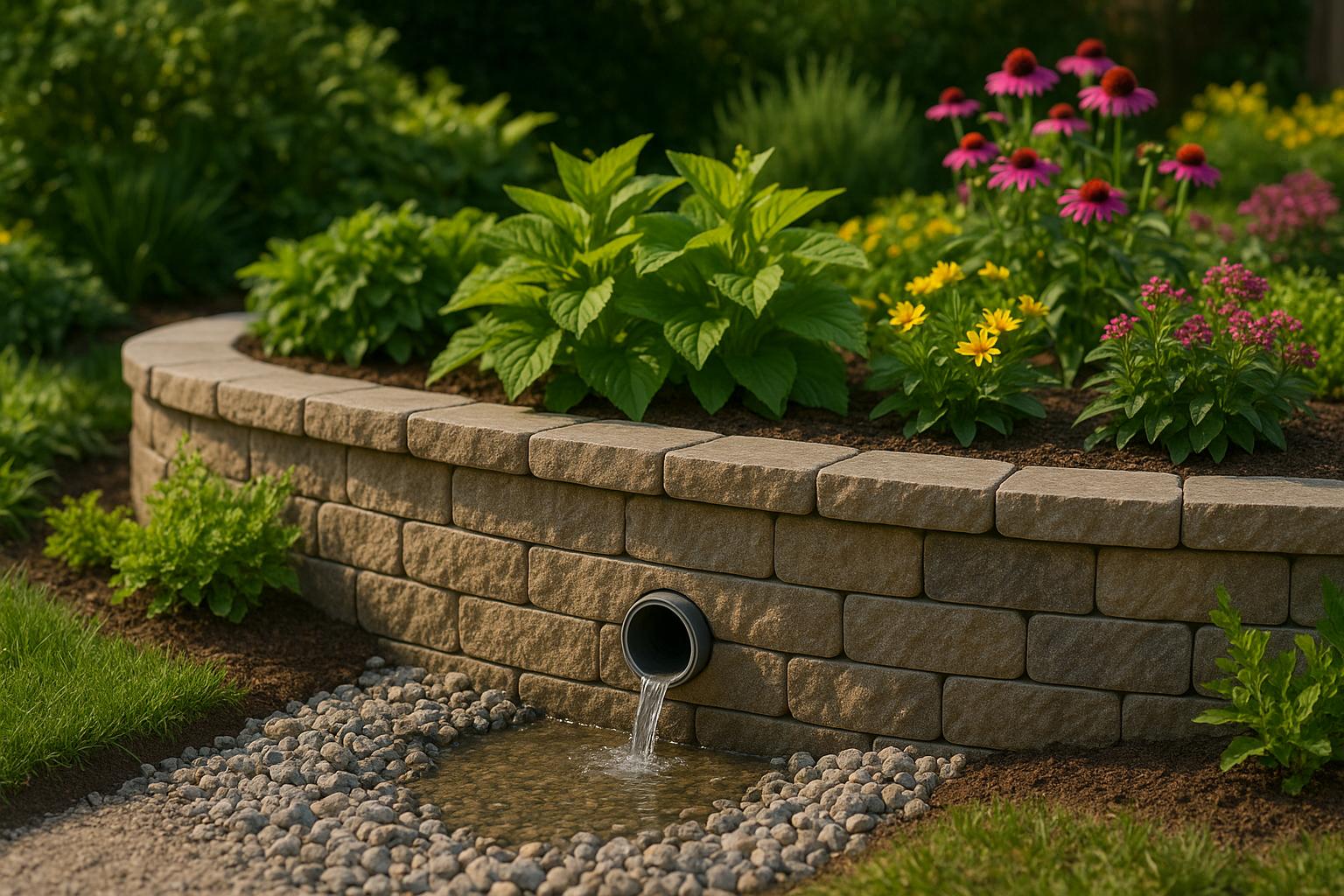
Retaining walls, terraces, and rock barriers provide physical support for soil on slopes. They break long slopes into shorter sections, hold soil behind them, and create flat areas where water can soak in instead of running off. A well-built retaining wall can reduce soil erosion by up to 90 percent on steep slopes, and it can increase usable yard space by as much as 50 percent. Hardscaping like this turns problem areas into functional outdoor space.
For properties with moderate to steep grades, combining walls with proper drainage and slope stabilization plantings provides the most complete protection.
4. Drainage Management
Even the best plants, mulch, and walls will fail if water overwhelms them. French drains, surface drains, swales, and proper yard grading move excess water away from sensitive areas before it can do damage. Alabama receives an average of about 56 inches of rainfall per year, according to the Alabama Office of the State Climatologist. That much water needs somewhere to go.
A professional drainage system makes sure water flows to safe discharge points instead of pooling on your lawn or against your foundation.
How to Prevent Soil From Pulling Away From a House
Soil pulling away from a house is one of the most common and most serious soil retention problems homeowners face. When you see a gap forming between the ground and your foundation wall, it means water is either washing the soil away or the soil is shrinking from drying out.
The fix starts with proper grading. The ground around your home should slope away from the foundation at a rate of about 3 to 5 percent for the first 10 feet. That means the soil 10 feet out from the house should be about 6 inches lower than the soil right at the foundation. If the grade is flat or slopes toward the house, water pools against the walls and erodes the soil from underneath.
Next, check your gutters and downspouts. Downspouts should discharge water at least 6 to 10 feet from the foundation. If they dump right at the base of the house, they create concentrated erosion exactly where you need the most soil stability.
Planting dense shrubs and ground covers around the foundation also helps. Their roots hold the soil in place, and their foliage slows rain before it hits the ground. Avoid planting large trees close to the foundation, though. A general rule is to plant trees at least as far from the house as their mature height. A tree that grows 30 feet tall should be at least 30 feet away.
For persistent problems, a French drain installed along the foundation perimeter collects subsurface water and redirects it away from the house. We have installed over 500 drainage systems and have seen firsthand how the right system stops soil from pulling away and protects the foundation long-term.
Will Rocks Keep Dirt From Washing Away?
Yes, rocks will keep dirt from washing away in many situations. Rocks work by armoring the soil surface, slowing water flow, and breaking up the energy of runoff. Riprap, which is rough, loose stone typically 6 to 8 inches wide, is one of the oldest and most proven erosion control methods. It is especially effective in areas with concentrated water flow, like the base of a downspout, alongside a driveway, or at the bottom of a slope.
However, rocks alone do not fix the underlying cause of erosion. They protect the surface but do not address subsurface water, compaction, or poor drainage patterns. Rocks also do not add organic matter to the soil or support plant growth. For the best results, use rocks in combination with drainage and vegetation. A dry creek bed lined with river rock, for example, catches surface runoff and guides it safely to a discharge point while looking attractive.
On flat yards or gentle slopes, rocks are a solid choice. On steep slopes, they can shift or roll downhill during heavy rain unless they are properly sized and installed.
What Is the Best Thing to Put Around the Foundation of a House?
The best thing to put around the foundation of a house is a combination of properly graded soil, a 2 to 3 inch layer of mulch or decorative rock, and low-growing shrubs or ground covers with dense root systems. This layered approach protects the soil from splash erosion, holds moisture levels steady so the soil does not shrink and pull away, and anchors everything with living roots.
Avoid piling soil directly against the foundation above the weep holes or siding line. The soil level should stay at least 6 inches below any wood or siding material. Mulch beds should slope gently away from the house, not create a dam that holds water against the walls.
For homes with chronic water problems around the foundation, a perimeter French drain combined with proper grading is the most effective long-term solution. It collects water before it reaches the foundation and moves it to a safe location. This is one of the most important investments a homeowner can make. FEMA data shows that flooding has impacted 99 percent of U.S. counties between 1996 and 2019, and nearly one-third of flood insurance claims come from outside high-risk flood zones. Poor drainage around a foundation creates the kind of slow, ongoing water damage that is easy to miss until it becomes expensive to fix.
Can I Add New Soil on Top of Old Soil?
Yes, you can add new soil on top of old soil, and it is a common way to rebuild areas that have lost topsoil to erosion. The practice is called topdressing. For lawns, a thin layer of compost or topsoil, about a quarter inch to half inch, spread evenly across the surface improves soil structure, adds nutrients, and helps the grass fill in thinner areas.
For garden beds or areas with significant soil loss, you can add 2 to 4 inches of quality topsoil or compost on top of the existing ground. Work it lightly into the top inch of the old soil with a rake to help the two layers bond together. If you just pile new soil on top without blending, you can create a water barrier between the layers that blocks drainage.
The quality of the new soil matters. Cheap fill dirt often has poor structure, minimal nutrients, and may even contain weed seeds. A soil amendment program that includes compost, organic material, and pH balancing gives your yard the strongest foundation for holding soil and growing healthy plants.
How to Pitch Soil Away From a House
To pitch soil away from a house, you need to create a gentle slope that directs water away from the foundation. The standard recommendation from foundation experts is a 3 to 5 percent grade for the first 10 feet outward from the house. In practical terms, that means the ground should drop about 6 inches over that 10-foot distance.
If your yard is too flat or slopes toward the house, you will need to add soil to build up the grade near the foundation and taper it down as you move away. Use quality topsoil, compact it lightly to prevent settling, and cover it with mulch or plant it with ground covers to keep it in place. Avoid clay-heavy fill material near the foundation, because clay expands and contracts with moisture changes and can create pressure against the walls.
After regrading, watch how water behaves during the next few rainstorms. If it still pools or flows toward the house, the grade may need further adjustment. Sometimes a swale or shallow drainage channel is needed to catch the water at the 10-foot mark and redirect it to a safe area of the yard. Professional landscape design accounts for all of these factors in a single plan.
What to Do Instead of a Retaining Wall
If a retaining wall is not in the budget or is not the right fit for your yard, there are several effective alternatives for holding soil on a slope. Terraced planting beds break a long slope into shorter, level sections using low borders of stone or timber. They are less expensive than a full retaining wall and work well on moderate slopes.
Bioengineering techniques use living plants as structural elements. Deep-rooted shrubs planted in rows along the contour of a slope act like natural walls, with their root systems providing physical support. Over time, the root network gets stronger and the plants get bigger, making this solution more effective as it ages.
Dry creek beds and swales redirect surface water without needing a wall. They work by giving the water a planned path to follow instead of letting it carve its own channel. A rock-lined swale combined with dense plantings on both sides can handle a surprising amount of runoff.
Erosion control blankets, also called biodegradable mats, cover bare soil and protect it while new plants get established. They are especially useful on freshly seeded slopes where the grass needs weeks to germinate. Once the plants fill in, the blanket breaks down naturally.
The best alternative depends on your slope, soil, and budget. In many cases, a combination of these methods provides better coverage than any single approach. Stopping erosion works best as a layered system, not a single solution.
Comparison: Soil Retention Techniques for Residential Yards
Soil Retention Methods ComparedTechniqueSoil Loss ReductionBest ApplicationMaintenanceMulching (wood/straw)Up to 76% (Geoderma meta-analysis)Flat to gentle slopes, garden beds, foundation areasReapply annuallyGround Cover Plants50-70% (USDA, FAO)Slopes, bare areas, under treesLow after establishmentRetaining WallUp to 90%Steep slopes, structural support near foundationsLow with proper drainageFrench DrainAddresses root cause (subsurface water)Foundation perimeters, waterlogged areas, slopesLow, periodic inspectionProper GradingPrevents pooling and redirects flowAround foundations, low spots, entire yardMinimal after initial gradingRock/RiprapHigh for concentrated flow areasDownspout discharge, swales, creek bedsVery lowTerracing60-80%Moderate to steep slopes, garden areasModerate
Sources: Geoderma (global meta-analysis of 90 studies), USDA NRCS, Food and Agriculture Organization (FAO), Oklahoma State University Extension, Penn State Extension.
How Soil Health Affects Retention
Healthy soil holds itself together far better than degraded soil. The USDA NRCS explains that healthy soil is about 50 percent solid particles and 50 percent pore space, with that pore space holding a mix of air and water. When soil is compacted, overworked, or stripped of organic matter, it loses its pore structure. Water cannot soak in, so it runs across the surface and takes soil with it.
Adding organic matter like compost improves soil structure by creating stable aggregates, which are clumps of soil particles held together by biological glue from microorganisms. These aggregates make the soil more porous, more absorbent, and more resistant to erosion. Research published in Frontiers in Sustainable Food Systems found that biochar, a type of charcoal-like soil amendment, can improve water retention by up to 30 percent.
In North Alabama, our soils tend to be heavy clay, which compacts easily and drains poorly. Regular soil improvement makes a big difference in how well the ground holds together during storms.
A professional soil amendment program that adds compost, adjusts pH, and improves drainage transforms problem soil into ground that holds together on its own.
Frequently Asked Questions
Is October Too Late to Mulch?
October is not too late to mulch. In fact, fall is one of the best times to apply mulch because it insulates plant roots against winter temperature swings, retains soil moisture heading into the drier months, and protects bare soil from erosion caused by fall and winter rains. In the Southeast, where winter rainfall is significant, a fresh layer of mulch in October provides protection during the wettest months of the year.
When Should You Not Mulch Your Lawn?
You should not mulch your lawn when the grass is already stressed from disease, when the soil is waterlogged, or when the mulch layer would smother the grass crowns. Thick mulch piled directly against grass can trap moisture and promote fungal growth. If you are mulching around garden beds next to a lawn, keep the mulch layer thin at the edge where it meets the turf so it does not bury the grass blades.
What Are 5 Disadvantages of Mulching?
Five disadvantages of mulching are that it can harbor pests like slugs and rodents in thick layers, it may introduce weed seeds if the mulch source is not clean, it can cause root rot if piled too thickly against plant stems, it needs to be reapplied annually as it breaks down, and lightweight mulch types can wash away on steep slopes during heavy rain. These drawbacks are manageable with proper application. Keep mulch 2 to 3 inches deep, pull it a few inches away from tree trunks and plant stems, and choose shredded hardwood over lightweight options for sloped areas.
What Does Putting Cinnamon on Top of Soil Do?
Putting cinnamon on top of soil is a home remedy some gardeners use to discourage fungal growth and deter small pests like gnats. Cinnamon has mild antifungal properties and can help prevent damping-off disease in seedlings. However, cinnamon does not improve soil retention, add nutrients, or provide meaningful erosion control. It is a minor gardening trick, not a soil management strategy.
What Is the 3-3-3 Rule for Mulch?
The 3-3-3 rule for mulch means applying 3 inches of mulch, keeping it 3 inches away from plant stems and tree trunks, and refreshing it every 3 months or as needed. This rule helps prevent the most common mulching mistakes: piling it too thick, suffocating plant stems by mounding mulch against them, and letting the layer get too thin to be effective. Following this guideline gives you strong soil protection without the risks of over-mulching.
Is It Pointless to Mulch in the Fall?
It is not pointless to mulch in the fall. Fall mulching protects soil from the increased rainfall and temperature fluctuations that come with the cooler months. It insulates roots, prevents frost heaving, and stops bare soil from eroding during winter storms. In regions like the Southeast that receive heavy winter rainfall, fall mulching is one of the most important seasonal tasks a homeowner can do to preserve soil health and prevent erosion.
Putting It All Together
Soil retention is not a single fix. It is a system of techniques that work together to keep your yard stable, your plants healthy, and your foundation protected. The best results come from combining proper grading, drainage, vegetation, mulch, and structural support where needed. Small problems get bigger with every rainstorm, so addressing them early saves money and prevents damage down the road.
If your yard is losing soil, developing bare patches, or showing signs of water damage near your foundation, White Shovel Landscapes can assess the problem and design a custom solution. Call us at 256-612-4439 to schedule a free site assessment and get your soil back where it belongs.



You May Also Like

Sep 12, 2026
3 min
How to Keep Landscape Edging Straight

Sep 11, 2026
3 min
How to Decorate a Patio: Ideas for 2025 and 2026
Sep 9, 2026
3 min
How to Trim Around Landscape Edging
Sep 7, 2026
3 min
What Does a Lawn Look Like After Aeration
Stay Connected and Inspired
Get the latest landscaping tips, seasonal care guides, and exclusive offers delivered straight to your inbox. Don’t miss out on expert advice and ideas to transform your outdoor spaces.
Sign Up for Our Newsletter Today!




Transforming Huntsville & Madison yards since 2010 with expert landscape design, garden makeovers, mulching, and top-quality installations.


