Providing Best Services in Huntsville & Madison, AL


Follow us on Social.





May 18, 2026


Landscaping
Soil Absorption in Saturated Yards
Soil absorption in saturated yards drops to nearly zero because every pore space in the ground is already full of water. When soil cannot absorb any more moisture, rain and irrigation water sit on the surface, kill grass roots, and turn your lawn into a soggy, muddy mess. In this article, we explain why soil gets saturated, how to test for it, and the best ways to restore your yard's ability to absorb water again.
Why Soil Absorption Fails in Saturated Yards
Soil absorption fails in saturated yards because the soil has run out of room to hold water. Healthy soil is roughly 50 percent solid particles and 50 percent pore space, according to the USDA Natural Resources Conservation Service. That pore space is where air and water live. When all of it fills with water, the soil is saturated, and nothing more can soak in.
Several things push a yard toward saturation. Heavy clay soil is one of the biggest. Clay particles are extremely small, so they pack tightly together with tiny pores that hold water stubbornly and drain very slowly. According to data from the University of Arizona, clay soil infiltrates water at roughly 0.10 inches per hour, compared to 2 inches per hour for sandy soil. That is a massive difference.
Compaction makes it worse. Years of foot traffic, mowing, and equipment use press the soil particles even closer together. This shrinks the pore space further and creates a hard layer that water cannot penetrate. The result is runoff, puddles, and a lawn that feels spongy for days after every rain.
Other causes include poor grading that sends water toward your house instead of away from it, clogged gutters that dump roof runoff into the same spot repeatedly, over-irrigation, and a high water table. In North Alabama, where clay-heavy soils are common, we see saturated yards more often than most homeowners expect.
How to Tell If Soil Is Oversaturated
To tell if soil is oversaturated, look for water that pools on the surface after rain and stays for more than a few hours, grass that feels spongy or squishes under your feet, and soil that sticks to your shoes in thick clumps. These are all signs that the ground has absorbed all the water it can hold.
You can also run a simple drainage test. According to Texas A&M University Extension, dig a hole about 12 inches deep and 12 inches wide and fill it with water. If the water drains in less than 3 hours, drainage is good. If it takes 3 to 12 hours, drainage is fair. If water is still sitting in the hole after 12 hours, your soil has a serious drainage problem that needs attention.
Other warning signs include yellowing grass, plants that wilt even though the ground is wet, a musty smell near the foundation, and visible erosion where water has carved channels through the soil. Root rot is another common symptom. When roots sit in water too long, they suffocate and decay because they cannot get the oxygen they need.
How to Fix Oversaturated Soil in the Yard
To fix oversaturated soil in the yard, you need to either help the soil absorb water better, move excess water away, or both. The right approach depends on what is causing the saturation. Compacted clay soil needs different treatment than a yard with bad grading or a broken gutter.
Here are the most effective methods, starting with the simplest.
Does Aerating Help With Soil Absorption?
Yes, aerating helps with soil absorption by punching holes through compacted layers so water, air, and nutrients can reach deeper into the ground. Core aeration, which pulls out small plugs of soil, is the most effective type for drainage improvement.
Regular core aeration combined with compost topdressing can improve water infiltration in high-clay soils compared with untreated turf. Over time, that combination also builds soil organic matter and reduces compaction.
Core aeration works best in the fall for cool-season grasses and late spring for warm-season grasses. The holes it creates are typically 2 to 3 inches deep and give water an immediate path into the soil. For severely compacted yards, aeration may need to be repeated once or twice a year until the soil structure improves.
How Organic Matter Improves Soil Absorption
Adding organic matter like compost is one of the best long-term fixes for saturated soil. Organic matter binds soil particles into aggregates, which creates larger pore spaces between them. Those larger pores let water flow through instead of sitting on the surface.
Amending soil with compost can increase how quickly water soaks in. Research from the Noble Research Institute also shows that increasing soil organic matter from 1 to 3 percent can reduce erosion by 20 to 33 percent, because the improved soil structure lets more water soak in and holds the soil together better.
The University of Nebraska-Lincoln recommends maintaining about 5 percent organic matter in your soil for healthy structure and good drainage. Most residential lawns test at only 1 to 2 percent. Spreading a thin layer of compost over your lawn after aeration, a process called topdressing, fills the core holes with nutrient-rich material and starts improving the soil from the inside out.
We see great results when soil amendment is combined with a proper drainage plan. The compost improves what the soil can handle on its own, and the drainage system takes care of the rest.
Can I Add New Soil on Top of Old Soil?
Yes, you can add new soil on top of old soil, but you need to do it correctly or you will create more problems. If you dump a thick layer of new topsoil over compacted or clay-heavy soil, you create two separate layers. Water moves through the top layer and then hits the dense old soil like a wall, pooling at the boundary between them.
The better approach is to add thin layers, no more than half an inch at a time on established grass, and let each layer work into the existing turf. For bare areas, you can apply a thicker layer of topsoil-compost mix, lightly compact it, and then seed or sod.
If the existing soil is severely compacted, aerate it first before adding anything on top. This breaks up the hard layer and gives the new soil a chance to integrate with the old. Tilling is another option for garden beds, but avoid tilling a lawn unless you plan to reseed the entire area.
Why Is My Lawn So Soft and Spongy?
A lawn that is soft and spongy is holding too much water in the soil or has a thick layer of thatch trapping moisture at the surface. When you step on a spongy lawn, you feel the ground give way because the soil is saturated and the grass roots are sitting in water instead of anchored in firm ground.
According to Oklahoma State University, saturated clay soils hold moisture at levels between 45 and 60 percent of their total volume. Sandy soils saturate at around 30 percent. So clay-heavy yards hold nearly twice as much water before they start to drain, and they take much longer to dry out once they are full.
Thatch buildup is another common cause. Thatch is a layer of dead grass stems, roots, and debris that builds up between the green blades and the soil surface. A thin layer of thatch is normal, but anything over half an inch starts to act like a sponge that keeps your lawn wet and prevents water from reaching the soil below.
Dethatching and aeration together can fix a spongy lawn in most cases. If the sponginess persists after those treatments, the problem is likely deeper, either a high water table, poor grading, or missing drainage that needs to be installed.
How Long Does It Take Saturated Soil to Dry Out?
How long it takes saturated soil to dry out depends on the soil type, temperature, wind, sunlight, and how much water it absorbed. Sandy soil can drain to field capacity in just a few hours. Loam soil takes about 1 to 2 days. Clay soil can take 2 to 3 days or longer, according to the Lake Worth Drainage District.
Field capacity is the point where gravity has pulled away the excess water and the soil holds just the moisture that plant roots can use. A soil at field capacity feels moist but not sticky. It does not pool water when you press on it.
If your yard stays soggy for more than 3 days after a rain with no new precipitation, the soil is not draining properly. That signals a compaction issue, a grading problem, or a lack of proper drainage. A well-functioning yard should return to usable condition within 24 to 48 hours after a typical rainstorm.
The longer saturated soil sits, the more damage it does. According to Kansas State University, just 48 hours of saturated conditions during plant germination can reduce germination rates by 30 to 70 percent. For established lawns, prolonged saturation suffocates roots and opens the door to fungal diseases like root rot and brown patch.
How to Dry Out a Saturated Yard
To dry out a saturated yard, you need to remove the standing water, improve the soil's ability to drain, and prevent the problem from happening again. Here is how to tackle it step by step.
First, check your gutters and downspouts. A typical 1,000-square-foot roof section produces over 600 gallons of runoff from just one inch of rain. If your downspouts are dumping that water right next to the house, extend them at least 5 to 10 feet away from the foundation. This single fix eliminates a surprising amount of yard saturation.
Second, aerate the compacted areas. Core aeration immediately opens up channels for water to move down through the soil instead of sitting on top. Follow up with a topdressing of compost to improve the soil structure over time.
Third, correct the grade. Your yard should slope away from the house at a minimum of 2 to 3 percent, which is about 2 to 3 inches of drop for every 10 feet of distance. If the ground is flat or slopes toward the house, water has no way to leave. Professional drainage solutions often start with regrading as the foundation for everything else.
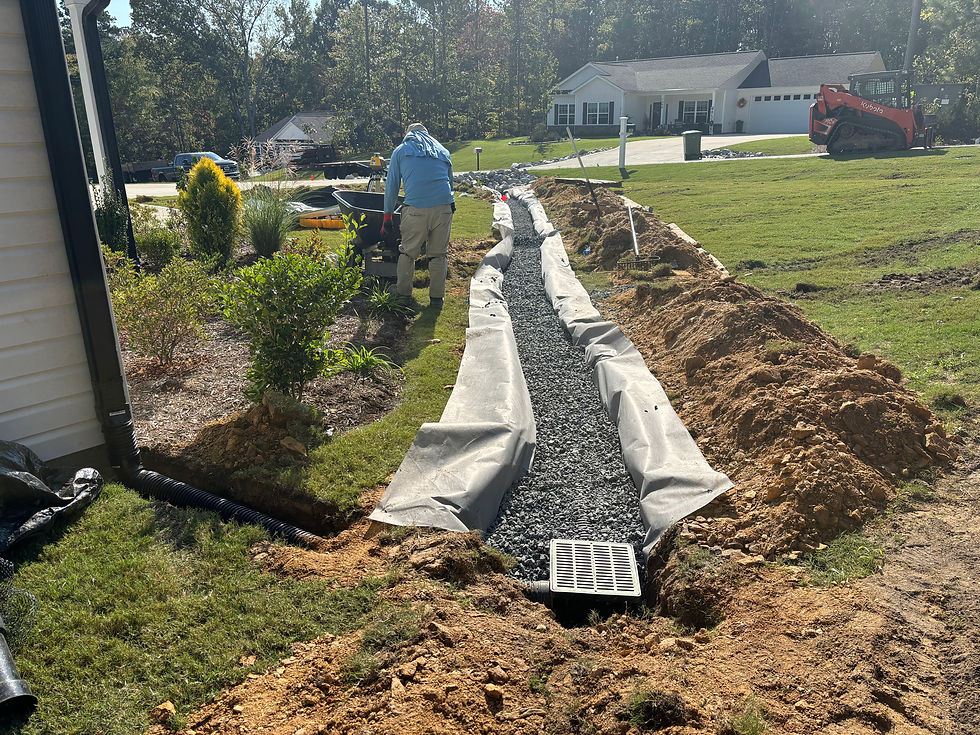
Fourth, install a drainage system if the saturation is chronic. French drains, catch basins, and dry wells all give water a place to go. According to research cited by the American Society of Civil Engineers, properly installed French drains can reduce foundation water pressure by up to 85 percent.
How to Firm Up a Soft Yard
To firm up a soft yard, you need to remove the excess moisture, reduce compaction, and rebuild the soil structure. A soft yard is a saturated yard, and the only way to firm it up for good is to fix the drainage.
Start by aerating the soft areas. The core holes let trapped water escape and allow air back into the soil. After aerating, topdress with a mix of compost and coarse sand. The sand improves drainage in the short term while the compost builds healthier soil over time.
Avoid driving heavy equipment or mowing on a soft yard. Every pass compresses the wet soil further, making it harder and denser once it finally dries. Wait until the ground firms up enough that your footprint does not sink more than half an inch.
For persistent soft spots that never seem to dry, the issue is almost always underground. It could be a broken pipe, a spring, or a section of the yard that collects runoff from a larger area. In those cases, a professional assessment is the fastest path to a real fix. We regularly help homeowners with muddy yards by identifying the water source and designing a system that handles it permanently.
Why Is My Yard So Saturated?
Your yard is saturated because more water is entering the soil than the soil can absorb or drain away. The most common reasons are heavy clay soil, poor grading, compaction, over-watering, clogged gutters, and a missing or broken drainage system.
Clay soils are the number one culprit in most saturated yards. Clay particles are less than 0.002 millimeters in diameter, according to the USDA soil classification system. They pack so tightly that water can barely squeeze through. When it rains hard or for an extended period, the water simply has nowhere to go.
Compaction from foot traffic and mowing compounds the problem. Ideal soil contains about 50 percent solid material and 50 percent pore space, according to the USDA NRCS. Compacted soil has far less pore space, which means less room for water and air. That is why a well-used path across your lawn often becomes the first place to flood.
Over-irrigation is another common and fixable cause. Many homeowners water on a fixed schedule regardless of weather conditions. If it rained two inches yesterday and your sprinklers still run this morning, you are pushing your soil past its capacity. Adjusting your watering schedule to account for rainfall is one of the easiest ways to reduce saturation.
Soil Absorption Rates by Soil Type
Soil TypeInfiltration Rate (inches per hour)Time to Drain After SaturationMoisture at SaturationSand2.0A few hours~30% volumetric water contentSandy Loam1.012 to 24 hours~35% volumetric water contentLoam0.51 to 2 days~45% volumetric water contentClay Loam0.252 to 3 days~50% volumetric water contentClay0.103+ days~60% volumetric water content
Sources: University of Arizona Department of Soil, Water and Environmental Science; Oklahoma State University Extension; Lake Worth Drainage District; USDA Natural Resources Conservation Service
How to Fix Overly Saturated Soil for Good
Fixing overly saturated soil for good requires a combination of soil improvement and water management. A single solution rarely does the job on its own. The most effective approach pairs soil amendments with a drainage system that handles excess water before it overwhelms the soil.
On the soil side, annual aeration and regular additions of organic matter gradually transform compacted clay into healthier, better-draining ground. According to the USDA Climate Hubs, increasing soil organic matter improves water-holding capacity, soil structure, and infiltration, while reducing erosion. These improvements build over seasons, not overnight, but they are lasting.
On the drainage side, systems like French drains, catch basins, and dry creek beds intercept and redirect water before it saturates the soil. Regrading corrects the slope so water flows away from structures and toward safe discharge areas. Downspout extensions carry roof water far enough from the house that it does not pool against the foundation.
The combination of soil health and drainage infrastructure is what separates a yard that stays soggy from one that handles even heavy rain without problems. According to FEMA, 98 percent of basements in the United States experience some form of water damage over their lifetime. Most of that damage connects directly back to how well the surrounding yard manages water.
How Standing Water From Saturated Soil Affects Your Home
Standing water from saturated soil puts your home at risk in several ways. The most serious is foundation damage. When water sits against a foundation wall, it creates hydrostatic pressure that pushes against the concrete. Over time, this causes cracks, leaks, and settling that can cost thousands to repair.
According to data compiled by iPropertyManagement, home water damage affects about 14,000 people in the United States every day. The average insurance payout for water damage is $13,954. Much of that damage is preventable with proper maintenance, including yard drainage.
Saturated soil also creates a perfect breeding ground for mosquitoes. The CDC advises eliminating all standing water around your home because mosquitoes can breed in as little as one teaspoon of stagnant water. According to Iowa State University Extension, it takes just 7 to 10 days of standing water for mosquitoes to complete their life cycle from egg to biting adult.
On top of that, saturated soil near your home can cause standing water that damages patios, walkways, and driveways. The freeze-thaw cycle in colder months pushes water into tiny cracks in concrete and expands them, breaking the surface apart over just a few seasons.
Plants That Help Absorb Water in Saturated Yards
Certain plants thrive in wet soil and actually help pull moisture out of the ground. Planting these in low spots or along drainage swales is a smart way to supplement your drainage system with a natural solution.
Deep-rooted native plants are the best choice. Their root systems create channels in the soil that water follows down instead of pooling on the surface. According to the EPA, rain gardens planted with native vegetation absorb 30 to 40 percent more water than a standard lawn. The deep roots also improve soil structure over time by breaking up compacted layers and adding organic matter as old roots decompose.
Good options for wet areas include daylilies, black-eyed Susans, switchgrass, river birch, and red twig dogwood. For homeowners who want something low-maintenance, we often recommend incorporating these plants into a rain garden that captures and filters runoff naturally.
Plants alone will not fix a severely saturated yard. But when paired with aeration, soil amendment, and proper drainage, they add another layer of protection and beauty that makes the whole system work better.
How Proper Drainage Protects Property Value
Yard drainage and property value go hand in hand. A soggy, eroded yard tells buyers that the home may have foundation problems, mold risks, and expensive repairs waiting. A dry, healthy yard signals a well-maintained property.
According to a Virginia Tech study, homes with quality landscaping sell for 5.5 to 12.7 percent more than similar homes without it. On a $300,000 property, that is $16,500 to $38,100 in added value. The National Association of Realtors also reports a 104 percent return on investment for landscape maintenance, meaning every dollar spent on keeping your yard in good shape comes back to you at resale.
On the other hand, research published in the Journal of Environmental Horticulture found that poor landscaping can reduce a home's value by 8 to 10 percent. Visible drainage problems, muddy areas, and dead grass all fall into that category.
Frequently Asked Questions
Which Soil Dries Out the Fastest?
Sandy soil dries out the fastest because its large particle size creates big pore spaces that water flows through quickly. According to the University of Arizona, sandy soil infiltrates water at about 2 inches per hour, which is 20 times faster than clay. After a rainstorm, sandy soil can drain back to field capacity in just a few hours, while clay may take 2 to 3 days or more.
What Soaks Up Water in a Yard Without Drainage?
What soaks up water in a yard without drainage is organic matter, deep-rooted plants, and amended soil. Adding compost to your soil improves its structure and creates more pore space for water absorption. Planting native grasses, shrubs, and perennials with deep root systems helps pull water down into the ground instead of letting it sit on the surface.
How to Fix Overly Saturated Soil?
To fix overly saturated soil, start by aerating to break up compaction, then add organic matter like compost to improve soil structure. Correct any grading issues so water flows away from your home. For chronic saturation, install a drainage system such as a French drain or catch basin to physically move excess water off the property.
What Are the Three Rules of Watering?
The three rules of watering are to water deeply, water less often, and water early in the morning. Deep watering encourages roots to grow down into the soil instead of staying at the surface. Watering less often lets the soil dry between sessions, which prevents saturation. Watering in the morning reduces evaporation loss and gives the lawn time to dry before nightfall, which lowers the risk of fungal disease.
How to Firm Up a Soft Yard?
To firm up a soft yard, aerate the soil to let trapped water escape, topdress with a compost and sand mix to improve structure, and correct any grading or drainage issues that are keeping the ground saturated. Avoid walking on or mowing soft ground, as that compresses the wet soil further and makes the problem worse once it dries.
Can I Add New Soil on Top of Old Soil?
Yes, you can add new soil on top of old soil, but keep each layer thin, no more than half an inch at a time, on established grass. For bare spots, thicker applications of topsoil-compost mix are fine. Always aerate compacted ground first so the new soil can blend with the old rather than sitting in a separate layer that blocks drainage.
What Is the Best Way to Improve Soil Absorption in Clay Yards?
The best way to improve soil absorption in clay yards is to combine core aeration with organic amendments. Compost amendments can increase how quickly water soaks into the soil. Aerate at least once a year, topdress with compost, and add a proper drainage system for areas that still hold water after treatment.
The Takeaway
Saturated soil is not something you can ignore and hope it gets better on its own. The longer water sits in your yard, the more damage it does to your grass, your soil, and your home's foundation. But the fix does not have to be overwhelming. Aeration, compost, proper grading, and the right drainage system work together to give your soil the ability to absorb water the way it should.
Every yard is different, and the best plan starts with knowing where the water is coming from and where it needs to go. If your lawn stays soggy, feels spongy, or pools water after every rain, White Shovel Landscapes can help you figure out what is going on and get it fixed. Call us at 256-612-4439 for a free site assessment.



You May Also Like

Sep 12, 2026
3 min
How to Keep Landscape Edging Straight

Sep 11, 2026
3 min
How to Decorate a Patio: Ideas for 2025 and 2026
Sep 9, 2026
3 min
How to Trim Around Landscape Edging
Sep 7, 2026
3 min
What Does a Lawn Look Like After Aeration
Stay Connected and Inspired
Get the latest landscaping tips, seasonal care guides, and exclusive offers delivered straight to your inbox. Don’t miss out on expert advice and ideas to transform your outdoor spaces.
Sign Up for Our Newsletter Today!




Transforming Huntsville & Madison yards since 2010 with expert landscape design, garden makeovers, mulching, and top-quality installations.


